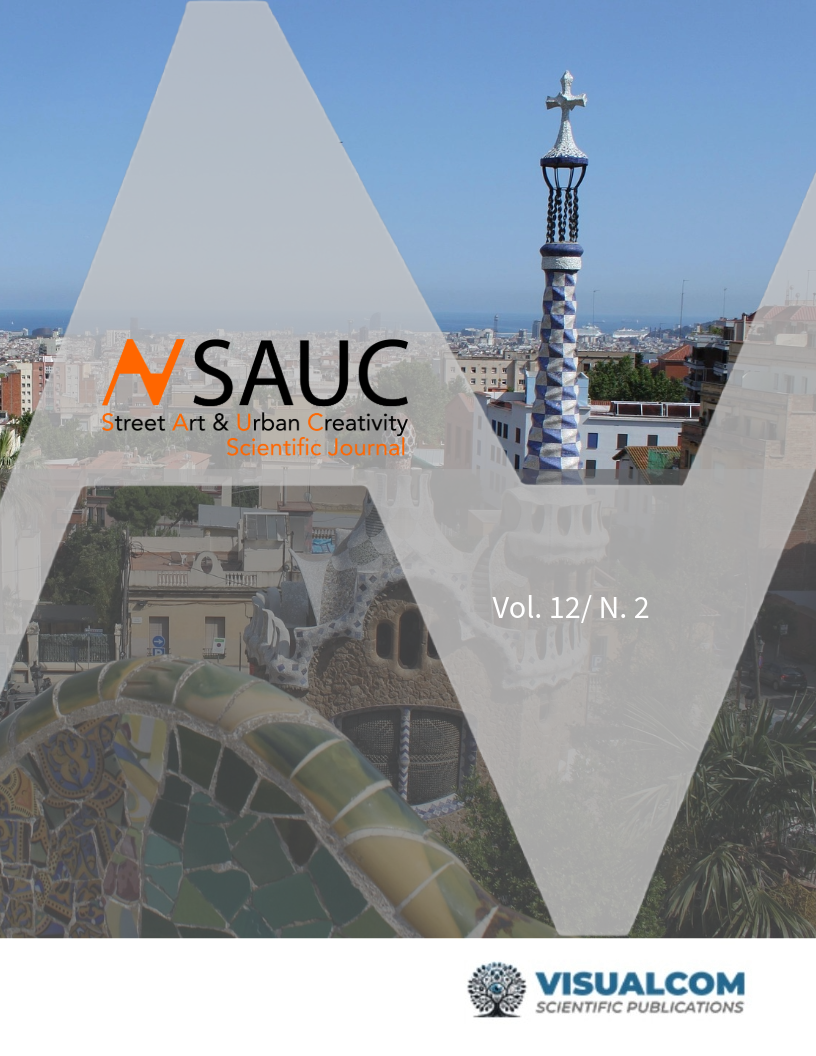
Casa Milà as a Sensory Laboratory
A Neuroarchitectural Approach to Gaudí’s Modernism
DOI:
https://doi.org/10.62161/sauc.v12.6133Keywords:
Neuroarchitecture, Gaudí, Casa Milà, Spatial complexity, Multisensory perception, Urban creativity, Cognitive-emotional responseAbstract
This article presents a neuroarchitectural methodological framework to analyze Antoni Gaudí’s architecture, focusing on Casa Milà (La Pedrera) as a multisensory environment. The research explores how spatial and formal complexity, light, and texture influence perception, memory, and emotion, integrating neurophysiological, behavioral, and subjective measures. An immersive experimental design is proposed to correlate architectural variables with brain and physiological responses, assessing spatial experience as a bodily and symbolic process. By positioning Gaudí’s work at the intersection of art and science, the study builds a bridge between architectural representation, cognition, and sensory urban experience. This approach offers a novel perspective to understand architecture as a neurocultural form of creativity, where aesthetic and spatial complexity engage the nervous system and shape the emotional and mnemonic dimensions of human-environment interaction.
Downloads
Global Statistics ℹ️
|
263
Views
|
248
Downloads
|
|
511
Total
|
|
References
Abbas, S., Okdeh, N., Roufayel, R., Kovacic, H., Sabatier, J.-M., Fajloun, Z., & Abi Khattar, Z. (2024). Neuroarchitecture: How the Perception of Our Surroundings Impacts the Brain. Biology, 13(4), 220. https://doi.org/10.3390/biology13040220
Altamura, M., Iuso, S., Balzotti, A., Francavilla, G., Dimitri, A., Cibelli, G., Bellomo, A., & Petito, A. (2018). Salivary alpha-amylase and cortisol responsiveness to stress in first episode, drug-naïve patients with panic disorder. Neuroscience Research, 137, 49–56. https://doi.org/10.1016/j.neures.2018.03.003
Azzazy, S., Ghaffarianhoseini, A., GhaffarianHoseini, A., Naismith, N., & Doborjeh, Z. (2020). A critical review on the impact of built environment on users’ measured brain activity. Architectural Science Review, 64(4), 319–335. https://doi.org/10.1080/00038628.2020.1749980
Berlyne, D. E. (1971). Aesthetics and psychobiology. Appleton-Century-Crofts.
Blázquez, J. L. (2023, 13 de abril). Disseny biofílic i neuroarquitectura a la Casa Vicens de Gaudí. Josep Lluís Blázquez entrevista a Ana Mombiedro y Alba Méndez [Emisión de radio]. Perspectiva. https://www.3cat.cat/3cat/disseny-biofilic-i-neuroarquitectura-a-la-casa-vicens-de-gaudi-amb-ana-mombiedro-i-alba-mendez/audio/1168647
Bolli, A. (2016). Gaudí – A legacy of craft. Journal of Architecture and Urbanism, 40(1), 56–67. https://www.researchgate.net/publication/301500764_Gaudi_-_A_Legacy_of_Craft
Bradley, M. M., & Lang, P. J. (1994). Measuring emotion: The self-assessment manikin and the semantic differential. Journal of Behavior Therapy and Experimental Psychiatry, 25(1), 49–59.
Casa Vicens. (2023). Taller de Ana Mombiedro y Alba Méndez. Casa Vicens Barcelona.
Condia, B., Arbib, M., Ellard, C., Chamberlain, B., & Rooney, K. (2020). Meaning in Architecture: Affordances, Atmosphere and Mood.
Cook, R., & Furnham, A. (2012). Personality and aesthetic preferences. Psychology of Aesthetics, Creativity, and the Arts, 6(3), 257–266.
Dehghani Tafti, M., Ahmadzad-Asl, M., Memarian, G., Fallah Tafti, M., Rajimehr, R., Soltani, S., Mirfazeli, F. S., Vahabie, A.-H., Moein, S. T., & Mozaffar, F. (2024). Personality traits can predict architectural preferences: A machine learning approach. Psychology of Aesthetics, Creativity, and the Arts, 18(5), 750–761. https://doi.org/10.1037/aca0000519
Dosde Publishing. (2023). La Pedrera. El último proyecto residencial de Antoni Gaudí. Dosde Publishing.
Eberhard, J. P. (2009). Brain Landscape: The Coexistence of Neuroscience and Architecture. Oxford University Press.
Ellard, C. (2015). Places of the Heart: The Psychogeography of Everyday Life. Bellevue Literary Press.
Farrow, T. (2024). Constructing Health: How the Built Environment Enhances Your Mind’s Health. University of Toronto Press
Freixa Serra, M. (2020). Dibujos, proyectos y maquetas. En Artika (Ed.), Gaudí en primer plano (pp. 161–239). Artika.
Fundació Catalunya La Pedrera. (s. f.). Historia de la Casa Milà. La Pedrera – Casa Milà. https://www.lapedrera.com/es/casa-mila/historia
Gibson, J. J. (1979). The ecological approach to visual perception. Houghton Mifflin.
Gregorians, L., Fernández Velasco, P., Zisch, F., & Spiers, H. J. (2022). Architectural experience: Clarifying its central components and their relation to core affect with a set of first-person-view videos. Journal of Environmental Psychology, 82. https://doi.org/10.1016/j.jenvp.2022.101841
Hill, D. (2018, 9 de julio). The “bland-demic”: Global homogenisation and the end of distinctiveness. CityLab. https://www.bloomberg.com/news/articles/2018-07-09/the-bland-demic-of-global-architecture
Johnson, J. M., & Kellogg, D. L. Jr. (1985). Local thermal control of the human cutaneous circulation. Journal of Applied Physiology, 109(4), 1229–1238. https://doi.org/10.1152/japplphysiol.00407.2010
Makanadar, A. (2024). Neuro-adaptive architecture: Buildings and city design that respond to human emotions and cognitive states. Research in Globalization, 8, 100222. https://doi.org/10.1016/j.resglo.2024.100222
Meirelles, F., Mendes, P., & Pereira, J. (2019). Geometric shape, structure and material in Antoni Gaudí’s work. Journal of Civil Engineering and Architecture, 13(11), 595–604. https://www.davidpublisher.com/Public/uploads/Contribute/5dd4f7aa863ac.pdf
Mirkia, H., Nelson, M. S., Abercrombie, H. C., Thorleifsdottir, K., Sangari, A., & Assadi, A. (2022). Recognition Memory for Interior Spaces with Biomorphic or Non–Biomorphic Interior Architectural Elements. Journal of Interior Design, 47(3), 47-66. https://doi.org/10.1111/joid.12224
Nasir, O., Akhtar, W., Iqbal, M. F., & Kamal, M. A. (2022). Analyzing the architecture of Antonio Gaudí with reference to Art Nouveau style: An inspiration from nature. Architecture Engineering and Science, 3(4), 309–319. https://doi.org/10.32629/aes.v3i4.1100
Negami, H. R., & Ellard, C. G. (2023). How architecture evokes awe: Predicting awe through architectural features of building interiors. Psychology of Aesthetics, Creativity, and the Arts, 17(1), 3. https://doi.org/10.1037/aca0000394
Pallasmaa, J. (2005). The Eyes of the Skin: Architecture and the Senses (2nd ed., illustrated). Wiley-Academy.
Passarelli, M., Masini, M., Bracco, F., Petrosino, M., & Chiorri, C. (2018). Development and validation of the Facial Expression Recognition Test (FERT). Psychological Assessment, 30(11), 1479–1490. https://doi.org/10.1037/pas0000595
Pinti, P., Tachtsidis, I., Hamilton, A., Hirsch, J., Aichelburg, C., Gilbert, S., & Burgess, P. W. (2020). The present and future use of functional near-infrared spectroscopy (fNIRS) for cognitive neuroscience. Annals of the New York Academy of Sciences, 1464(1), 5–29. https://doi.org/10.1111/nyas.13948
Robinson, S., & Pallasmaa, J. (2015). Mind in Architecture: Neuroscience, Embodiment, and the Future of Design. MIT Press.
Sharpe, C., Beltrán Rodríguez, M., Pichel, M. & Josa, M. (2024). Memory and space: Rethinking lecture hall design through the principles of neuroarchitecture. En Actas del Congreso Internacional de Diseño, Innovación y Nuevas Tecnologías (CIDiNova 2024). https://cidinova.org/ponencia/memory-and-space-rethinking-lecture-hall-design-through-the-principles-of-neuroarchitecture/
Srikantharajah, J., & Ellard, C. (2025). The physiological and psychological impact of boring buildings: Field studies of the effects of architectural façade complexity.
Tawil, N., & Kühn, S. (2024). The built environment and the brain: Review of emerging methods to investigate the impact of viewing architectural design. En B. Leupen, C. Grafe, N. Künig, M. Lampe, & P. de Zeeuw (Eds.), Environmental Neuroscience (pp. 169–226). Springer. https://doi.org/10.1007/978-3-031-64699-7_9
Vartanian, O., Navarrete, G., Palumbo, L., & Chatterjee, A. (2021). Individual differences in preference for architectural interiors. Journal of Environmental Psychology, 77, 101668. https://doi.org/10.1016/j.jenvp.2021.101668
Downloads
Published
How to Cite
Issue
Section
License
Copyright (c) 2026 Authors retain copyright and transfer to the journal the right of first publication and publishing rights

This work is licensed under a Creative Commons Attribution-NoDerivatives 4.0 International License.
Those authors who publish in this journal accept the following terms:
-
Authors retain copyright.
-
Authors transfer to the journal the right of first publication. The journal also owns the publishing rights.
-
All published contents are governed by an Attribution-NoDerivatives 4.0 International License.
Access the informative version and legal text of the license. By virtue of this, third parties are allowed to use what is published as long as they mention the authorship of the work and the first publication in this journal. If you transform the material, you may not distribute the modified work. -
Authors may make other independent and additional contractual arrangements for non-exclusive distribution of the version of the article published in this journal (e.g., inclusion in an institutional repository or publication in a book) as long as they clearly indicate that the work was first published in this journal.
- Authors are allowed and recommended to publish their work on the Internet (for example on institutional and personal websites), following the publication of, and referencing the journal, as this could lead to constructive exchanges and a more extensive and quick circulation of published works (see The Effect of Open Access).