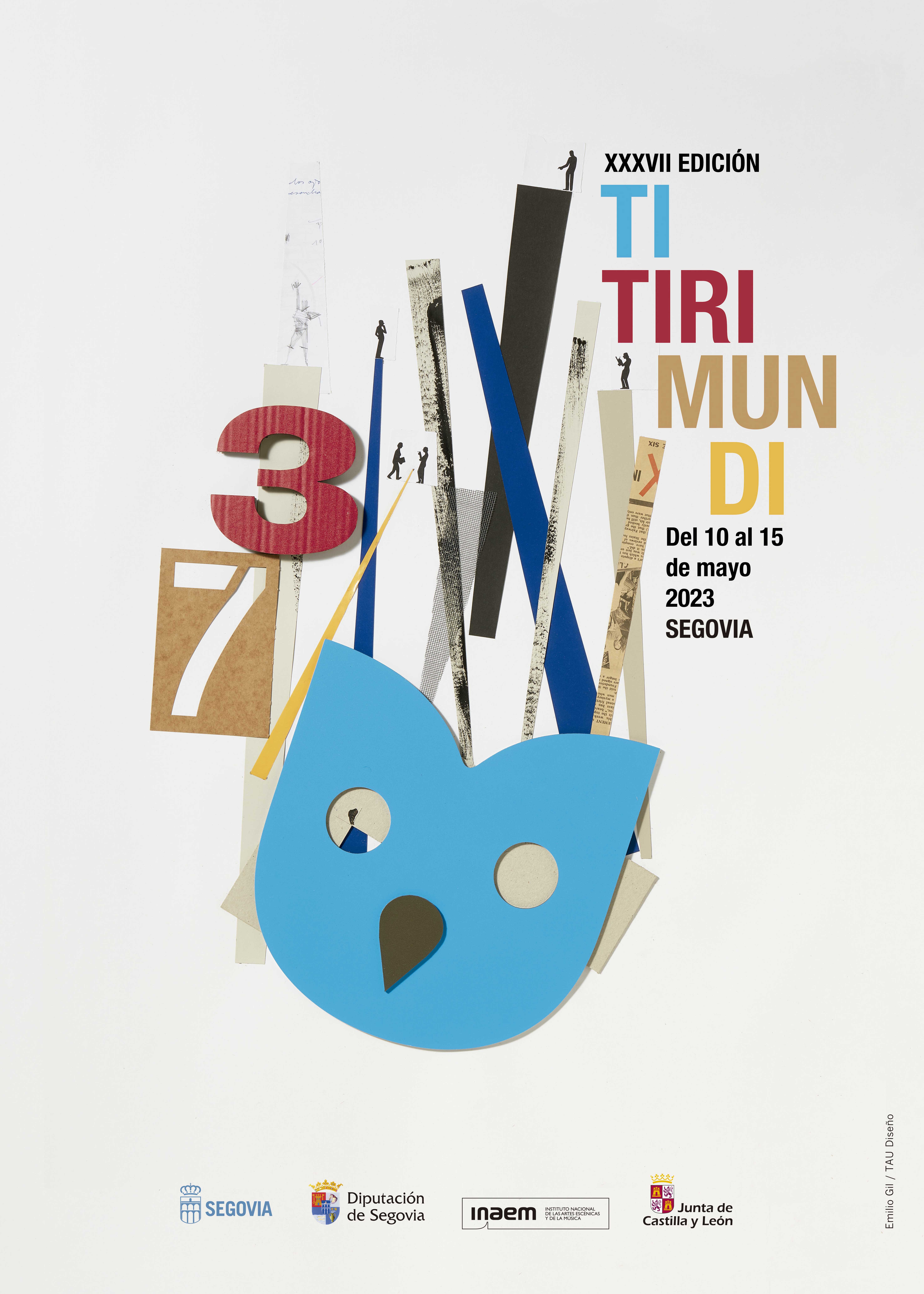
Creativity in Titirimundi, international festival of puppet theatre in Segovia
Creativity from the city, the plays to the advertising posters
DOI:
https://doi.org/10.62161/sauc.v11.5644Keywords:
Creativity, Puppetry, Theater, Titirimundi, Advertising, Posters, Festival, SegoviaAbstract
This article shows the importance of the Titirimundi Festival for creativity in its genre. An international puppet theatre festival held in Segovia in the month of May each year.
A festival with worldwide prestige and outstanding in the creativity of puppetry, from the theatre plays represented to the communication through its advertising posters, of which an analysis of the last 5 years is proposed.
An event that every year demonstrates its creativity not only because each piece represented is above all creative: original by the person who represents it and created for that purpose, but also because of the way it is communicated from the poster, which is also inspiring.
A festival that breaks the mould and expresses itself from new, original and outstanding designs in all its actions, showing in each of them great artistic-creative expression.
Downloads
Global Statistics ℹ️
|
268
Views
|
327
Downloads
|
|
595
Total
|
|
References
Acero y magia (s.f.). Figura Marioneta de Pinocchio Disney. https://www.aceroymagia.com/figuras-cartoons/Clasicos-Disney-y-Princesas/figura-Pinocchio-marioneta-disney
Acueducto2.com (2020). Titirimundi: Un cartel 2020 «made in» Palacio de Quintanar. https://www.acueducto2.com/titirimundi-un-cartel-2020-made-in-palacio-de-quintanar/94710
Araya, Y. C. (2005). Una revisión crítica del concepto de creatividad. Actualidades Investigativas en Educación, 5(1), 0.
Arroyo, J. L. B, (2005). Sociolingüística del español. Desarrollos y perspectivas en el estudio de la lengua española en contexto social. Cátedra.
Benney, M., & Hughes, E.C. (1970). Of sociology and the Interview: Editorial Preface. The American Journal of Sociology, LXII(2), 137-142. DOI: https://doi.org/10.1086/221953
Bernete, F. (2013). Análisis de contenido. In A. Lucas Marín & A. Noboa (Coords.) Conocer lo social: estrategias y técnicas de construcción y análisis de datos (pp.193-203). Fragua/ Fondo de Cultura Universitaria.
Campos, M. (2006) Aplicación de los títeres como recurso didáctico en los centros infantiles de Quito en el sector de la Mitad del Mundo para niños de cinco a seis años de edad. Universidad de Ecuador.
Cebrian B. (2024) El títere y su valor educativo. Análisis de su influencia en Titirimundi: Festival internacional del interés de Segovia. [Doctoral thesis] Universidad de Valladolid. https://doi.org/10.35376/10324/16249 DOI: https://doi.org/10.35376/10324/16249
Corbalán, F.J., Martínez, F., & Donolo, D. (2015). CREA. Inteligencia creativa. Una medida cognitiva de la creatividad. TEA Ediciones.
De la Piñera, S., & Trigo, E. (2000). Manifestaciones de la modernidad. INDE Publicaciones.
Diputación de Segovia (s.f.). https://www.dipsegovia.es/agenda/-/calendarsuite/event/947574/4WHN8uEJks4A
Educacionhijos.es (s.f.). Cómo crear una marioneta casera. https://educacionhijos.es/crear-una-marioneta-casera.html
El Día de Segovia. (23 de junio de 2021). Los vencejos protagonizan el cartel de Titirimundi 2021. https://www.eldiasegovia.es/noticia/z3c62db58-b514-91ff-2a16056e1e868e4f/202106/los-vencejos-protagonizan-el-cartel-de-titirimundi-2021
García del Toro, A. (2004). Comunicación y expresión oral y escrita: la dramatización como recurso. Graó.
Guilford, J. P. (1977) La naturaleza de la inteligencia humana, Paidós.
Hernández, C. (1999) Manual de Creatividad Publicitaria. Síntesis.
López, A. M. (2023). La entrevista en profundidad y la observación directa: observaciones cualitativas para un enfoque holístico. En J. M. Moreno Carrillo & J. M. Cortés Martí (coord.) Caminos de utopía: Las ciencias sociales en las nuevas sociedades inteligentes (pp. 739-749). Uno Editorial.
Mackinnon, D. W. (1962). The Nature and Nurture of Creative Talent. American Psy-chologist, 17(7), 484-495. https://doi.org/10.1037/h0046541 DOI: https://doi.org/10.1037/h0046541
Martín-Casado T.G. y Vazquez, M. (2024) Cómo hacer estrategias creativas en publicidad. Contenidos para medios del siglo XXI. En F. García Garcia, R. Rodrigo, M. De Miguel (Eds.) Creatividad en la narrativa publicitaria. (pp 143-162) Dykinson. DOI: https://doi.org/10.14679/2852
Martín-Casado T.G, (2010). El tratamiento de género en la creación del mensaje publicitario del medio prensa a comienzos del siglo XXI. [Doctoral thesis] Universidad Complutense de Madrid. https://hdl.handle.net/20.500.14352/25644
Morales, A. (2011) El rito, el títere y el niño. En Y. E. Brugal & B. Rizk (Eds.) Rito y presentación: Los sistemas mágico-religiosos en la cultura cubana contemporánea (pp. 229-246). Vervuert Verlagsgesellschaft. https://doi.org/10.31819/9783865278050-020 DOI: https://doi.org/10.31819/9783865278050-020
Navarro, C. (2014) Creatividad publicitria eficaz. Esic
Pérez-Ugena, A. Martínez Pastor, E., & Martínez A. (2011). Los estereotipos de géneros en la publicidad de los juguetes. Ámbitos. Revista Internacional de Comunicación, 20. https://revistascientificas.us.es/index.php/Ambitos/article/view/9882 DOI: https://doi.org/10.12795/Ambitos.2011.i20.11
Restaurantejosemaria.com. (s.f.). https://www.restaurantejosemaria.com/wp-content/uploads/2023/05/Cartel-TITIRIMUNDI-2023-1.jpg
Ricarte, J.M. (2003) La publicidad en España. En J. Villafañe (Ed.) El Estado de la publicidad y el corporate en España y Latinoamérica: la gestión de los intangibles empresariales: informe anual 2003, (pp. 85-98) Universidad Complutense de Madrid.
Rioseco, E. (2010). Manual de títeres. Fundación la fuente.
Rogozinski, V. (2001). Títeres en la escuela: expresión, juego y comunicación. Noveduc Libros.
Taylor, S. J., & Bogdan, R. (2008). La entrevista en profundidad. Métodos cuantitativos aplicados, 2, 194-216.
Títeres Taller Albaida (s.f.). Títeres de guiñol de animales. https://www.titerestalleralbaida.com/titeres-de-gui-ol-de-animales
Titirimundi.es (s.f.). https://titirimundi.es/ediciones-anteriores/2024/
Trigo, E. y Piñera, S. (2000)Manifestaciones de la motricidad. Inde.
Tur-Viñes,V., Núñez-Gómez, P., & González-Río, M.J. (2018). Menores influyentes en YouTube. Un espacio para la responsabilidad. Revista Latina de Comunicación Social, 73, 1211-1230.: https://doi.org/10.4185/RLCS-2018-1303 DOI: https://doi.org/10.4185/RLCS-2018-1303
Villena, Hugo. (2001) Títeres en la escuela. Ediciones Colihue.
Whittaker, R. H. (1977). Towards a Theory for Reference and Information Service. Journal of Librariabship and Information Science, 9(1). https://doi.org/10.1177/096100067700900105 DOI: https://doi.org/10.1177/096100067700900105
Downloads
Published
How to Cite
Issue
Section
License
Copyright (c) 2025 Authors retain copyright and transfer to the journal the right of first publication and publishing rights

This work is licensed under a Creative Commons Attribution-NoDerivatives 4.0 International License.
Those authors who publish in this journal accept the following terms:
-
Authors retain copyright.
-
Authors transfer to the journal the right of first publication. The journal also owns the publishing rights.
-
All published contents are governed by an Attribution-NoDerivatives 4.0 International License.
Access the informative version and legal text of the license. By virtue of this, third parties are allowed to use what is published as long as they mention the authorship of the work and the first publication in this journal. If you transform the material, you may not distribute the modified work. -
Authors may make other independent and additional contractual arrangements for non-exclusive distribution of the version of the article published in this journal (e.g., inclusion in an institutional repository or publication in a book) as long as they clearly indicate that the work was first published in this journal.
- Authors are allowed and recommended to publish their work on the Internet (for example on institutional and personal websites), following the publication of, and referencing the journal, as this could lead to constructive exchanges and a more extensive and quick circulation of published works (see The Effect of Open Access).