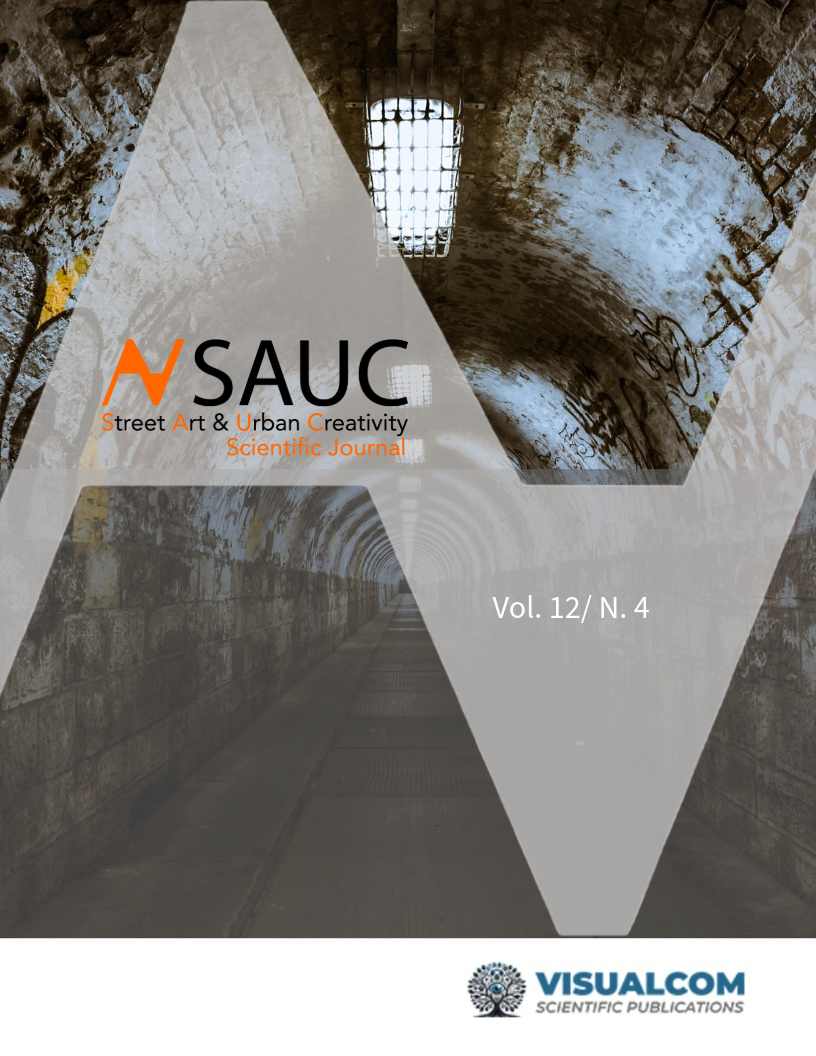
Monumentality and Urban Myth: Labyrinth, Absence and Sacrality in Public Art
Site-specific interventions and the aesthetics of dislocation in the creative city
DOI:
https://doi.org/10.62161/sauc.v12.6179Keywords:
Public art, Critical monumentality, Counter-monuments, Collective memory, Urban labyrinth, Creative cityAbstract
This article examines a series of artistic interventions that critically reconfigure monumentality in contemporary public space. Through the analysis of five paradigmatic cases—Peter Eisenman’s Memorial to the Murdered Jews of Europe in Berlin, Rachel Whiteread’s Nameless Library in Vienna, Gregor Schneider’s domestic installations, Anselm Kiefer’s monumental ruins, and SPY’s Golden Monoliths in Lille—the study explores how these works destabilize official narratives of memory and generate experiences of disruption within urban life. Findings show that these interventions do not resolve debates on memory but rather open them, addressing inhabitants through the body, affect, and liminal experience. The article concludes that a truly democratic creative city is not defined by the number of artworks it hosts but by their ability to interrupt, unsettle, and re-signify everyday urban experience.
Downloads
Global Statistics ℹ️
|
92
Views
|
75
Downloads
|
|
167
Total
|
|
References
Benjamin, W. (2005). The Arcades Project (H. Eiland & K. McLaughlin, Eds. & Trans.). Harvard University Press.
Böhme, G. (2017). Aesthetic Capitalism. Routledge.
Eisenman, P. (2005). Memorial to the Murdered Jews of Europe [Obra pública]. Berlín, Alemania.
Freud, S. (1919). Das Unheimliche. In Gesammelte Werke (Vol. 12, pp. 229–268). Frankfurt: Fischer.
Garrido Castellano, C. (2022). Beyond Representation: Cultural Practices and Political Imaginaries in Contemporary Public Art. Routledge.
Garrido Castellano, C., & Raposo, P. (2023). Creativity at the margins: Public art, cultural agency and urban transformation. Public Art Dialogue, 13(2), 121–137. https://doi.org/10.1080/21502552.2023.2173139
Kiefer, A. (2015). Instalaciones y arquitecturas de ruina [Obra artística]. Diversos emplazamientos.
Krzyżanowska, N. (2016). The discourse of counter-monuments: Semiotics of material commemoration in contemporary urban spaces. Social Semiotics, 26(5), 465–485. https://doi.org/10.1080/10350330.2015.1096132
Lehtinen, S. (2019). New public monuments: Urban art and everyday aesthetic experience. Open Philosophy, 2(1), 30–38. https://doi.org/10.1515/opphil-2019-0004
Martínez García-Posada, A., & Navarro de Pablos, A. (en prensa). Fisuras en la memoria: el deterioro material como potencia en el Memorial de Berlín. Arquitectura y Memoria.
Nora, P. (1993). Entre mémoire et histoire: Les lieux de mémoire. París: Gallimard.
Oteiza, J. (1963). Quousque tandem...! Ensayo de interpretación estética del alma vasca. San Sebastián: Auñamendi.
Pavoni, A. (2019). Speculating on (the) urban (of) art: (un)siting street art in the age of neoliberal urbanisation. Horizontes Antropológicos, 25(55), 51–88. https://doi.org/10.1590/S0104-71832019000300003
Salvatori, G. (2015). Il nuovo monumento: tra estetica e memoria. In Arte, memoria e spazio urbano (pp. 115–132). Milán: FrancoAngeli.
Schneider, G. (2004). Haus u r. Köln: Walther König.
Schneemann, J. (2013). Monumentalism as a rhetoric of impact. Journal of Aesthetics & Culture, 5(1), 95–110. https://doi.org/10.3402/jac.v5i0.21013
SPY. (2021). Golden Monoliths [Intervención urbana]. Lille, Francia.
Vila Vázquez, J. I. (2008). La monumentalidad a través de la imagen y el simbolismo del lugar. SymCity, 2, 1–12. https://hal.science/hal-02293210
Whiteread, R. (2000). Nameless Library [Monumento]. Judenplatz, Viena, Austria.
Young, J. E. (1992). The Counter-Monument: Memory against Itself in Germany Today. Critical Inquiry, 18(2), 267–296. https://doi.org/10.1086/448632
Downloads
Published
How to Cite
Issue
Section
License
Copyright (c) 2026 Authors retain copyright and transfer to the journal the right of first publication and publishing rights

This work is licensed under a Creative Commons Attribution-NoDerivatives 4.0 International License.
Those authors who publish in this journal accept the following terms:
-
Authors retain copyright.
-
Authors transfer to the journal the right of first publication. The journal also owns the publishing rights.
-
All published contents are governed by an Attribution-NoDerivatives 4.0 International License.
Access the informative version and legal text of the license. By virtue of this, third parties are allowed to use what is published as long as they mention the authorship of the work and the first publication in this journal. If you transform the material, you may not distribute the modified work. -
Authors may make other independent and additional contractual arrangements for non-exclusive distribution of the version of the article published in this journal (e.g., inclusion in an institutional repository or publication in a book) as long as they clearly indicate that the work was first published in this journal.
- Authors are allowed and recommended to publish their work on the Internet (for example on institutional and personal websites), following the publication of, and referencing the journal, as this could lead to constructive exchanges and a more extensive and quick circulation of published works (see The Effect of Open Access).