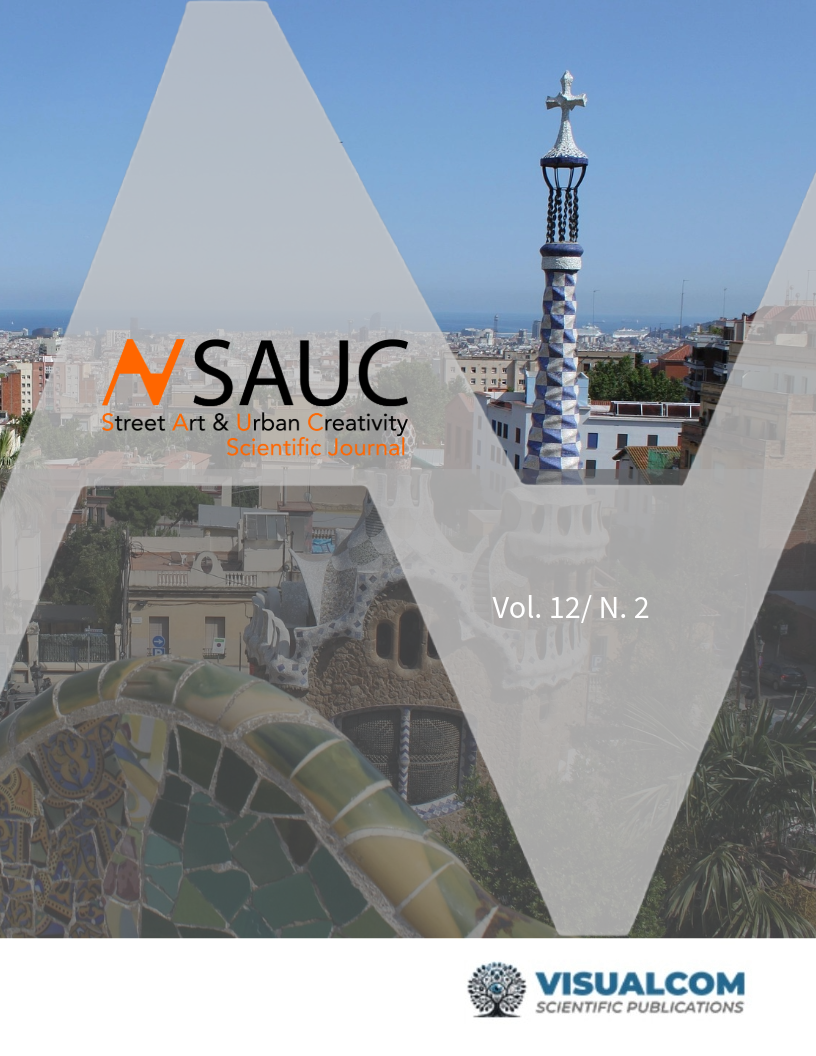
Gaudí in Shaping Contemporary Urban Landscape Identity
Performativity of Form, Urban Performativity and Heritage-Making in Architecture, Street and Digital Media
DOI:
https://doi.org/10.62161/sauc.v12.6131Keywords:
Antoni Gaudí, Architectural heritage, Urban identity, Urban creativity, Street art, Visual cultureAbstract
The study analyses how Antoni Gaudí’s legacy is reinterpreted in contemporary architecture, urban art and digital mediations. Combining a morphological and performative approach focused on motifs such as trencadís, organic geometries and growth simulations with an urban and cultural approach, Gaudí is studied as an urban attractor and an identity resource. In turn, artistic work linked to his buildings is subjected to tensions between heritage preservation, touristification and artistic experimentation. Methodologically, a documentary review and analysis are carried out of architectural referents, Hundertwasser, Bofill and Calatrava; urban artists who employ mosaics and ceramics, Invader, Ememem; and recent cases such as videomapping of Casa Batlló, digital projections on the Sagrada Família and murals with Gaudian iconography in Barcelona and Milan. The results reveal the existence of a “living Gaudí” that, between critique and spectacle, through culture contributes to the construction of an urban identity.
Downloads
Global Statistics ℹ️
|
425
Views
|
966
Downloads
|
|
1391
Total
|
|
References
ABC. (2024, 22 de abril). La Sagrada Familia usa la IA para fusionar la rosa y el arte de Gaudí con motivo de Sant Jordi. ABC. https://www.abc.es/cultura/sagrada-familia-usa-ia-fusionar-rosa-arte-20240422145106-vi.html
Ajuriaguerra Escudero, M. A., & Di Guglielmo, O. (2025). The Role of Creative Industries in Urban Regeneration: A Comparative Study of London and Bogotá. Street Art & Urban Creativity, 11(1), 111–136. https://doi.org/10.25765/sauc.v11.5687
Álvarez Arce, R., Galván-Desvaux, N., & Martínez-Rodríguez, J. M. (2020). Building the Walden 7: The model as patrimony of the design process. En L. Agustín-Hernández, J. M. Navarro, & A. C. Herrera (Eds.), Graphical Heritage. EGA 2020 (pp. 108–117). Springer. https://doi.org/10.1007/978-3-030-47983-1_10
Álvarez Arce, R., Galván Desvaux, N., & Martínez Rodríguez, J. M. (2021). Maquetas y vivienda modular: la experiencia del taller de arquitectura de Ricardo Bofill. EGA Expresión Gráfica Arquitectónica, 26(43), 182-193. https://doi.org/10.4995/ega.2021.14537
AV (2014). El caso de Santiago Calatrava. Un iceberg de trencadís. Arquitectura Viva. https://arquitecturaviva.com/articulos/el-caso-de-santiago-calatrava
AVIXA. (2024, 16 de diciembre). Multimedia artist Quayola to enhance ISE 2025 with Casa Batlló projection mapping, keynote and exclusive showcase performance. https://www.avixa.org/about-us/press-room/2024/12/16/multimedia-artist-quayola-to-enhance-ise-2025-with-casa-batll%C3%B3-projection-mapping--keynote--and-exclusive-showcase-performance Avixa Portal
AVIXA. (2025, 28 de febrero). Video mapping global projects: Casa Batlló’s 2025 mapping delights over 110,000 guests. https://xchange.avixa.org/posts/around-the-world-in-projection-mapping-casa-batllo-s-2025-performance-delights-110-000-guests
Bacharach, S. (2015). Street art and consent. The British Journal of Aesthetics, 55(4), 481–495. https://doi.org/10.1093/aesthj/ayv030
Baldini, A. L. (2022). What is street art? Estetika: The European Journal of Aesthetics, 59(1), 1–21. https://doi.org/10.33134/eeja.234
Barak, N. (2017). Hundertwasser—Inspiration for environmental ethics: Reformulating the ecological self. Environmental Values, 26(3), 317–342. https://doi.org/10.3197/096327117X14913285800689
Basili, G. (2021, 26 de julio). Nuovo murales di Cosimo Cheone a Milano che dialoga con Portaluppi. Artribune. https://www.artribune.com/arti-visive/street-urban-art/2021/07/murale-cosimo-cheone-milano/
Bassegoda Nonell, J. (2002). Gaudí o espacio, luz y equilibrio. Criterio Libros.
Bengtsen, P. (2020). The monetization of the street art world and the fossilization of urban public space. Visual Inquiry, 9(1–2), 45–58. https://doi.org/10.1386/vi_00009_1
Bofill Leví, A. (1975). Contribución al estudio de la generación geométrica de forms arquitectónicas y urbanas. [Tesis] UPC. https://doi.org/10.5821/dissertation-2117-96091
Calatrava, S. (2015, 16 de septiembre). ArchDaily Interview – Architects & Engineers (interview). https://calatrava.com/news/reader/archdaily-interview.html
Cardellicchio, L., & Tombesi, P. (2021). Learning from Failures: Reflections on the Role of Project Design and Design Management in the Procurement of Non-Standard Buildings. Buildings, 11(6), 253. https://doi.org/10.3390/buildings11060253
Castro, W., Souza, J., Gaspar, P., & Silva, A. (2023). Mapping the Risk of Occurrence of Defects in Façades with Ceramic Claddings. Buildings, 13(5), 1209. https://doi.org/10.3390/buildings13051209
Casa Batlló (2025, 3 de febrero). Casa Batlló’s 2025 mapping thrills 110,000 attendees. https://contemporary.casabatllo.es/en/news/casa-batllos-2025-mapping-thrills-110000-attendees/
Casa Batlló (n.d.). Casa Batlló Mapping. https://contemporary.casabatllo.es/en/mapping/
Catalan News. (2024, 12 de abril). Sagrada Familia celebrates Sant Jordi with AI art projection. Catalan News. https://www.catalannews.com/culture/item/sagrada-familia-celebrates-sant-jordi-with-ai-art-projection
Cité Création. (s.f.). Les Balcons de Barcelone. https://citecreation.fr/actualites/balcons-catalans-barcelone-espagne-citecreation-fete-40-ans-2018/
Chiavoni, E. (2017). Architecture, colour and images. Ideas and designs by Friedensreich Hundertwasser. Proceedings, 1(9), 953. https://doi.org/10.3390/proceedings1090953
Conde Melguizo, R., Santín Álvarez, E., & Alonso Urbano, D. (2025). Methodology for the digitalization of heritage through interactive technologies and artificial intelligence: Experience with the Residencia de Estudiantes de Madrid in the PLATA project. Street Art & Urban Creativity, 11(3), 1–16. https://doi.org/10.62161/sauc.v11.5739
Curralo, A. F. (2015). Preserving Urban Heritage and Creativity: The Reuse of the AXA Building in Porto. Street Art & Urban Creativity, 1(2), 14–21. https://doi.org/10.25765/sauc.v1i2.24
Degen, M. (2008). Sensing Cities: Regenerating Public Life in Barcelona and Manchester. Routledge. https://doi.org/10.4324/9780203895511
De Souza Sánchez, P.M. (2025). Sustainable Urban Innovation: Correlations between Art, Society, and Individuals in fostering Creative Neighborhoods. En R. Castanho, G. Hayder, & S. Ahmed (eds) Urban Identity Explored: Architecture and Arts in Cities. CITAA 2023. Advances in Science, Technology & Innovation. Springer, Cham. https://doi.org/10.1007/978-3-031-60641-0_22
De Souza Sánchez, P. M., Ferrer Román, E., & Naranjo Henríquez, I. (2023). Coordination and methodological innovation of the drawing activities of the degree in Architecture: Revisión del submódulo de dibujo del Grado en Fundamentos de la Arquitectura como adaptación al Espacio Europeo de Educación Superior. HUMAN REVIEW: International Humanities Review/ Revista Internacional de Humanidades, 17(1), 1–27. https://doi.org/10.37819/revhuman.v17i1.1557
El País. (2014, 8 de enero). El Palau de les Arts cierra por riesgo de desprendimientos. El País. https://elpais.com/ccaa/2014/01/08/valencia/1389190480_414383.html
El País. (2025, 2 de febrero). La Casa Batlló se convierte en un florido bosque con un «mapping» audiovisual en su fachada. El País. https://elpais.com/espana/catalunya/2025-02-02/la-casa-batllo-se-convierte-en-un-florido-bosque-con-un-mapping-audiovisual-en-su-fachada.html
Església de Barcelona. (2024, 12 de abril). La Sagrada Familia instala una proyección de arte digital creada con IA por Sant Jordi. https://esglesia.barcelona/es/actualitat/la-sagrada-familia-instala-una-proyeccion-de-arte-digital-creada-con-ia-por-sant-jordi/
Eveleigh, R. (2023, 3 de enero). The guerrilla artist filling Europe’s potholes with colourful mosaics. Positive News. https://www.positive.news/society/the-guerrilla-artist-filling-europes-potholes-with-colourful-mosaics/
Freixa, M., & Saliné, M. (2022). The Starting Point of the Arabic-Andalusi Influence in Gaudi’s Ornamental Ceramic: The Pavilions Güell (1884-1887). Manazir Journal, 3, 131-144. https://doi.org/10.36950/manazir.2021.3.9
Gómez-Ramió, J., Cavalaro, S., & Aguado, A. (2015). The Trencadis Mosaic on the Pinnacles of the Sagrada Familia Cathedral. International Journal of Architectural Heritage, 9(5), 594–604. https://doi.org/10.1080/15583058.2013.834089
Guido, G. (2021, 27 de julio). Milano come Barcellona grazie al murale di Cheone. Collater.al. https://www.collater.al/cheone-the-vision-milano-street-art/
Gutiérrez-Mozo, M. E., González-Avilés, A., & Martínez-Millana, E. (2024). The feminist perspective as a counterpoint in architecture: Anna Bofill Levi. Frontiers in Sustainable Cities, 6, 1348827. https://doi.org/10.3389/frsc.2024.1348827
Huerta, S. (2006). Structural design in the work of Gaudí. Architectural Science Review, 49(4), 324–337. https://doi.org/10.3763/asre.2006.4943
Hundertwasser, F. (1953). The straight line leads to the downfall of our civilization. https://hundertwasser.com/en/texts/die_gerade_linie_fuehrt_zum_untergang
Hundertwasser, F. (1958). Mouldiness manifesto against rationalism in architecture. https://hundertwasser.com/en/texts/verschimmelungsmanifest_gegen_den_rationalismus_in_der_architektur
Hundertwasser, F. (1971). Forestation of the city. https://hundertwasser.com/en/texts/verwaldung_der_staedte
Hundertwasser, F. (1985). The uneven floor. https://hundertwasser.com/en/texts/der_unebene_boden
Hundertwasser, F. (1991). The third skin. https://hundertwasser.com/en/texts/die_dritte_haut
Hundertwasser, F. (1996 [1rst version 1980]). Tree tenants are the ambassadors of the free forests in the city. https://hundertwasser.com/en/texts/baummieter_sind_die_botschafter_des_freien_waldes_in_der_stadt
Jobson, C. (2015). Treats in the Streets: Artist Jim Bachor fills potholes with ice cream mosaics. Colossal. https://www.thisiscolossal.com/2015/05/treats-in-the-streets-jim-bachor/
Kraftl, P. (2009). Living in an artwork: The extraordinary geographies of the Hundertwasser-Haus, Vienna. Cultural Geographies, 16(1), 111–134. https://doi.org/10.1177/1474474008097982
Krippendorff, K. (2018). Content analysis: An introduction to its methodology (4th ed.). SAGE.
McQuaid, M. (1993). Santiago Calatrava: Structure and Expression. The Museum of Modern Art. https://assets.moma.org/documents/moma_catalogue_391_300295421.pdf
Miles, M. (2015). Limits to culture: Urban regeneration vs. dissident art. Pluto Press.
Montaner, J. M. (1999). La modernidad superada: arquitectura, arte y pensamiento del siglo XX. GG.
Moreno, J. (2017, 31 de enero). El Auditorio perderá toda su «piel» de cerámica por los desperfectos. Diario de Avisos. https://diariodeavisos.elespanol.com/2017/01/auditorio-perdera-toda-piel-ceramica-los-desperfectos/
Palou-Rubio, S. (2019). Usos turístics del patrimoni i història del turisme a Barcelona. Revista d’Etnologia de Catalunya, (44), 121–134. https://raco.cat/index.php/RevistaEtnologia/article/view/370118
Phillips, I. (2022, 11 de septiembre). France’s answer to Banksy: The anonymous street artist filling potholes with colourful mosaics. The Guardian. https://www.theguardian.com/artanddesign/2022/sep/11/frances-answer-to-banksy-the-anonymous-street-artist-filling-potholes-with-colourful-mosaics
Quayola (2025). Arborescent. Casa Batlló Contemporary. https://contemporary.casabatllo.es/mapping/arborescent/
Redazione (2021, 1 de agosto). A Milano nasce un murale ispirato a Casa Battló di Gaudì: è «The Vision» di Cheone. Finestre sull’Arte. https://www.finestresullarte.info/arte-contemporanea/milano-murale-the-vision-cheone-ispirato-gaudi
Rose, G. (2016). Visual methodologies: An introduction to research with visual materials (4th ed.). SAGE.
Rueda, S. (2019). Superblocks for the design of new cities and renovation of existing ones: Barcelona’s case. En M. Nieuwenhuijsen & H. Khreis (Eds.), Integrating human health into urban and transport planning (pp. 135–153). Springer. https://doi.org/10.1007/978-3-319-74983-9_8
Sagrada Família. (2024). Sagrada Família installs digital art projection created with AI for Sant Jordi. https://sagradafamilia.org/en/-/la-sagrada-familia-instal-la-una-projeccio-d-art-digital-creada-amb-ia-per-sant-jordi
Sagrada Familia. (s.f.). Rosa, Rosae. https://sagradafamilia.org/en/rosa-rosae
Schacter, R. (2016). Ornament and order: Graffiti, street art and the parergon. Routledge. https://doi.org/10.4324/9781315599113
Stager, J. (2012). The Embodiment of Color in Ancient Mediterranean Art. UC Berkeley. https://escholarship.org/uc/item/5p21q1tx
Tsimpou, T. (2025, 3 de febrero). Quayola reimagines Gaudí’s Casa Batlló facade with swaying digital arboreal forms. Designboom. https://www.designboom.com/art/casa-batllo-facade-quayola-digital-arborescent-mapping-projection-11-19-2024/
Tripadvisor. (s.f.). Mural balcones de Barcelona [Attraction page]. https://www.tripadvisor.es/Attraction_Review-g187497-d20295446-Reviews-Mural_Balcones_de_Barcelona-Barcelona_Catalonia.html
UNESCO. (2005). Works of Antoni Gaudí. World Heritage Centre. https://whc.unesco.org/en/list/320/
Urquía Uriaguereca, Í. (2025). Urban art and neighborhood-brand identity: The case of Lavapiés and its representation on Instagram. Street Art & Urban Creativity, 11(5). https://doi.org/10.62161/sauc.v11.5642
Yin, R. (2018). Case study research and applications: Design and methods. SAGE.
Zerbst, R. (2019). Antoni Gaudí: A life devoted to architecture. Taschen.
Downloads
Published
How to Cite
Issue
Section
License
Copyright (c) 2026 Authors retain copyright and transfer to the journal the right of first publication and publishing rights

This work is licensed under a Creative Commons Attribution-NoDerivatives 4.0 International License.
Those authors who publish in this journal accept the following terms:
-
Authors retain copyright.
-
Authors transfer to the journal the right of first publication. The journal also owns the publishing rights.
-
All published contents are governed by an Attribution-NoDerivatives 4.0 International License.
Access the informative version and legal text of the license. By virtue of this, third parties are allowed to use what is published as long as they mention the authorship of the work and the first publication in this journal. If you transform the material, you may not distribute the modified work. -
Authors may make other independent and additional contractual arrangements for non-exclusive distribution of the version of the article published in this journal (e.g., inclusion in an institutional repository or publication in a book) as long as they clearly indicate that the work was first published in this journal.
- Authors are allowed and recommended to publish their work on the Internet (for example on institutional and personal websites), following the publication of, and referencing the journal, as this could lead to constructive exchanges and a more extensive and quick circulation of published works (see The Effect of Open Access).