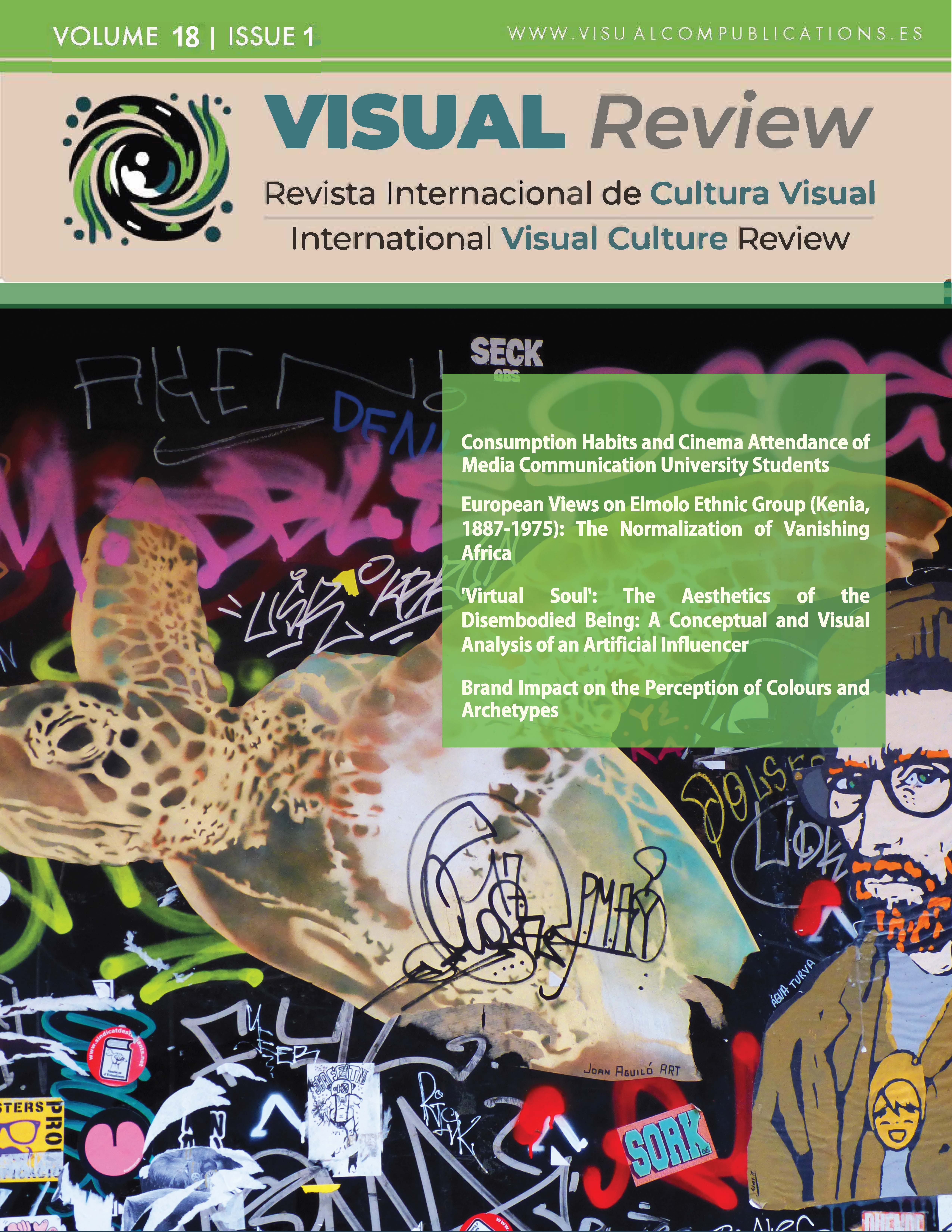
Impacto de la marca en la percepción de colores y arquetipos
DOI:
https://doi.org/10.62161/revvisual.v18.5967Palabras clave:
Colores, Marcas, Arquetipos, Arquetipos de marca, PercepcionesResumen
Este estudio examina cómo el color se alinea con los arquetipos de marca y si las identidades de marca influyen en la relación entre los arquetipos y la percepción del color. Utilizando la teoría de los arquetipos junguianos, la psicología del color y la literatura de branding, la investigación investiga cómo los consumidores asocian naturalmente los colores con los arquetipos, las marcas con los colores y las marcas con los arquetipos. Se utilizó una encuesta transversal (N=281) y un diseño experimental de tres partes. En general, los hallazgos sugieren que aunque las narrativas arquetípicas y de marca influyen en la interpretación simbólica de los colores, las marcas no modifican ni median fuertemente estas asociaciones. Esta investigación proporciona perspectivas teóricas sobre el papel simbólico del color en el branding y enfatiza la influencia limitada que las marcas tienen en las conexiones inconscientes entre el color y el arquetipo.
Descargas
Estadísticas globales ℹ️
|
894
Visualizaciones
|
351
Descargas
|
|
1245
Total
|
|
Citas
Aslam, M. M. (2006). Are You Selling the Right Colour? A Cross‐cultural Review of Colour as a Marketing Cue. Journal of Marketing Communications, 12(1), 15-30. https://doi.org/10.1080/13527260500247827
Bellizzi, J. A., Crawley, A. E., & Hasty, R. W. (1983). The effects of color in store design. Journal of Retailing, 59(1), 21-45.
Baronio, C., et al. (2022). Development of Visual Identity and Positioning of a Design Agency Based on Archetypes. Quaestum, 3, 1-15. https://doi.org/10.22167/2675-441x-20220623
Broek, N. uit het. (2014). The Visualization of Archetypes through the Use of Colors in Logos [MA Thesis]. https://essay.utwente.nl/64830/1/Broek%20uit%20het%20Niels%20-s%200171115%20scriptie.pdf
Chang, W.-L., & Lin, H.-L. (2010). The impact of color traits on corporate branding. African Journal of Business Management, 4(15), 3344–3355. https://doi.org/10.5897/AJBM.9000586
Ciotti, G. (2014, May 15). The Psychology of Color in Marketing and Branding. Help Scout. https://www.helpscout.com/blog/psychology-of-color/
Crozier, W. R. (1996). The psychology of colour preferences. Review of Progress in Coloration and Related Topics, 26(1), 63–72. https://doi.org/10.1111/j.1478-4408.1996.tb00111.x
Crowley, A. E. (1993). The two-dimensional impact of color on shopping. Marketing Letters, 4(1), 59-69. https://doi.org/10.1007/bf00994188
Cunningham, M. K. (2017). The Value of Color Research in Brand Strategy. Open Journal of Social Sciences, 05(12), 186–196. https://doi.org/10.4236/jss.2017.512014
De Vaus, D. (2013). Surveys in social research. Routledge. https://doi.org/10.4324/9780203519196
Funk, D., & Oly Ndubisi, N. (2006). Colour and product choice: a study of gender roles. Management Research News, 29(1/2), 41-52. https://doi.org/10.1108/01409170610645439
Gorn, G. J., Chattopadhyay, A., Tracey, Y., & Dahl, D. W. (1997). Effects of color as an executional cue in advertising: They’re in the shade. Management Science, 43, 1387-1400. https://doi.org/10.1287/mnsc.43.10.1387
Grossman, R. P., & Wisenblit, J. Z. (1999). What we know about consumers' color choices. Journal of Marketing Practice: Applied Marketing Science, 5(3), 78-88. https://doi.org/10.1108/eum0000000004565
Gunter, B. (1999). Media Research Methods: Measuring Audiences, Reactions, and Impact.
Haddad, L., et al. (2015). Archetypes and Brand Image: An International Comparison. Rcaap.pt, Nov. 2015. http://comum.rcaap.pt/entities/publication/8f27a93f-c4f3-4138-a5d9-8aa7381941c2
Jung, C. (1959). The archetypes and the collective unconscious. In H. Read, M. Fordham, & G. Adler (Eds.), Collected Works (Vol. 9, Part 1). Princeton, NJ: Princeton University Press.
Kumar, J. S. (2017). The Psychology of Colour Influences Consumers’ Buying Behaviour - A Diagnostic Study. Ushus - Journal of Business Management, 16(4), 1-13. https://doi.org/10.12725/ujbm.41.1
Labrecque, L. I., & Milne, G. R. (2012). Exciting red and competent blue: the importance of color in marketing. Journal of the Academy of Marketing Science, 40(5), 711-727. https://doi.org/10.1007/s11747-010-0245-y
Labrecque, L. I., Patrick, V. M., & Milne, G. R. (2013). The marketers’ prismatic palette: A review of color research and future directions. Psychology & Marketing, 30(2), 187-202. https://doi.org/10.1002/mar.20597
Lohse, G. L., & Rosen, D. L. (2001). Signaling quality and credibility in Yellow Pages advertising: The influence of color and graphics on choice. Journal of Advertising, 30(2), 73-83. https://doi.org/10.1080/00913367.2001.10673639
Itten, J. (1961). The Art of Color. Wiley.
Mark, M., & Pearson, C. (2001). The hero and the outlaw: Building extraordinary brands through the power of archetypes. New York, NY: McGraw-Hill.
Mehta, R., & Zhu, R. J. (2009). Red or blue? Exploring the effects of color on cognitive task performances. Science, 323(February), 1226-1229. https://doi.org/10.1126/science.1169144
Osgood, C. E., Suci, G. J., & Tannenbaum, P. H. (1957). The Measurement of Meaning. Urbana, IL: University of Illinois Press.
Priluck Grossman, R., & Wisenblit, J. Z. (1999). What we know about consumers’ color choices. Journal of Marketing Practice: Applied Marketing Science, 5(3), 78-88. https://doi.org/10.1108/eum0000000004565
Siraj, S., & Kumari, S. (2011). Archetyping the Brand: Strategy to Connect. The IUP Journal of Brand Management, VIII(3), 47–59. https://www.researchgate.net/publication/256023093_Archetyping_the_Brand_Strategy_to_Connect
Singh, N., & Srivastava, S. K. (2011). Impact of colors on the psychology of marketing — a comprehensive overview. Management and Labour Studies, 36(2), 199-209. https://doi.org/10.1177/0258042x1103600206
Singh, S. (2006). Impact of color on marketing. Management Decision, 44(6), 783-789. https://doi.org/10.1108/00251740610673332
Sliburyte, L., & Skeryte, I. (2014). What we know about consumers’ color perception. Procedia - Social and Behavioral Sciences, 156, 468-472. https://doi.org/10.1016/j.sbspro.2014.11.223
Yu, L., Westland, S., Li, Z., Pan, Q., Shin, M. J., & Won, S. (2017). The role of individual colour preferences in consumer purchase decisions. Color Research & Application, 43(2), 258-267. https://doi.org/10.1002/col.22180
Descargas
Publicado
Cómo citar
Número
Sección
Licencia
Derechos de autor 2026 Los autores/as conservan los derechos de autor y ceden a la revista el derecho de la primera publicación y el derecho de edición

Esta obra está bajo una licencia internacional Creative Commons Atribución-SinDerivadas 4.0.
Los autores/as que publiquen en esta revista aceptan las siguientes condiciones:
- Los autores/as conservan los derechos de autor.
- Los autores/as ceden a la revista el derecho de la primera publicación. La revista también posee los derechos de edición.
- Todos los contenidos publicados se regulan mediante una Licencia Atribución/Reconocimiento-SinDerivados 4.0 Internacional. Acceda a la versión informativa y texto legal de la licencia. En virtud de ello, se permite a terceros utilizar lo publicado siempre que mencionen la autoría del trabajo y a la primera publicación en esta revista. Si transforma el material, no podrá distribuir el trabajo modificado.
- Los autores/as pueden realizar otros acuerdos contractuales independientes y adicionales para la distribución no exclusiva de la versión del artículo publicado en esta revista (p. ej., incluirlo en un repositorio institucional o publicarlo en un libro) siempre que indiquen claramente que el trabajo se publicó por primera vez en esta revista.
- Se permite y recomienda a los autores/as a publicar su trabajo en Internet (por ejemplo en páginas institucionales o personales), una vez publicado en la revista y citando a la misma ya que puede conducir a intercambios productivos y a una mayor y más rápida difusión del trabajo publicado (vea The Effect of Open Access).