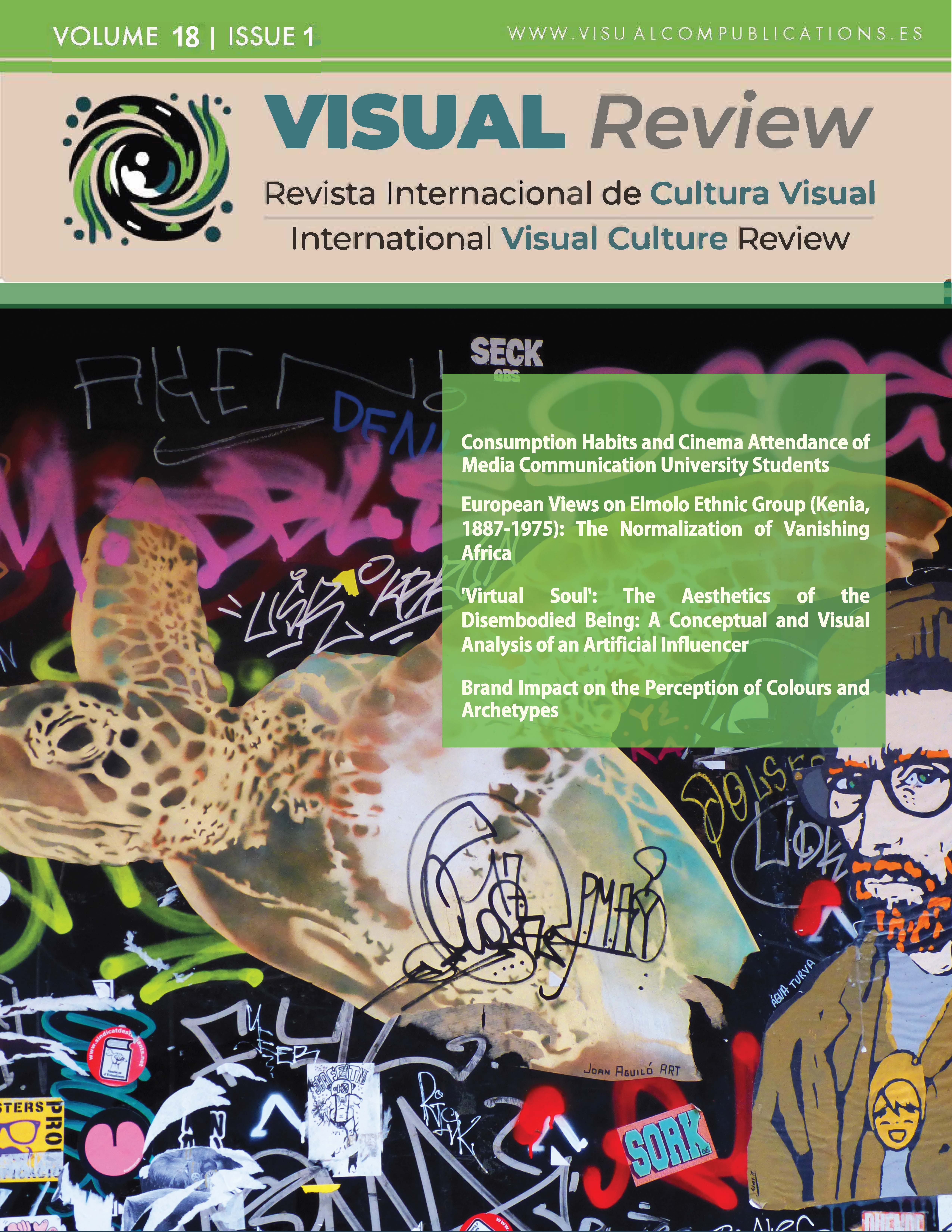
‘Virtual Soul’: La Estética del Ser sin Cuerpo
Análisis Conceptual y Visual de una Influencer Artificial
DOI:
https://doi.org/10.62161/revvisual.v18.5976Palabras clave:
Cuerpo, Redes Sociales, Inteligencia artificial, Hiperrealidad, Estética, Instagram, InfluencersResumen
En la era posdigital, categorías como cuerpo, identidad y presencia experimentan una profunda reconfiguración. Desde el caso de Aitana López, influencer virtual creada con inteligencia artificial, esta investigación explora las nuevas formas de existencia tecnológicamente mediadas. Se analizan tres dimensiones clave: la existencia como visibilidad, el cuerpo como interfaz estética sin experiencia y la imagen como forma de presencia ontológica. Asimismo, se constata una tendencia hacia la hiperrealidad y la estetización del cuerpo, donde lo artificial adquiere primacía sobre lo real. El análisis se realiza desde un enfoque hermenéutico-visual aplicado al contenido de su perfil de Instagram. La imagen visual ya no sólo representa, sino que actúa, genera deseo, interacción y valor. En este escenario, se requiere representar lo humano sin desligarlo de su dimensión encarnada.
Descargas
Estadísticas globales ℹ️
|
388
Visualizaciones
|
457
Descargas
|
|
845
Total
|
|
Citas
Abendroth, N. (2024). ¿Es real o es inteligencia artificial? Los influencers virtuales y la confusión en torno a su identidad. Un estudio sobre la influencer virtual española Aitana López. [Trabajo de Fin de Grado, Universidad de Valladolid]. TFG-N 2418. https://uvadoc.uva.es/handle/10324/70329
Asimov, I. (1942). Runaround. Astounding, 29(1), 94-103. https://tinyurl.com/59nh8bkd
Asimov, I. (1985). Robots and Empire. Doubleday Books.
Auriemma, V., Battista, D., & Quarta, S. (2023). Digital Embodiment as a Tool for Constructing the Self in Politics. Societies, 13(12), 261. https://doi.org/10.3390/soc13120261
Barboza, R. A. (2025). Influencers no humanos en Instagram: entre el posfeminismo y el transhumanismo. Aposta. Revista de Ciencias Sociales, 104, 113-126. http://apostadigital.com/revistav3/hemeroteca/rabarboza.pdf
Baudrillard, J. (1978). Cultura y simulacro. Editorial Kairós.
Belting, H. (2001). An anthropology of images: Picture, medium, body. Princeton University Press.
Berkeley, G. (1710/2020). Tratado sobre los principios del conocimiento humano. Editorial Verbum.
Boehm, G. (1994). Die Wiederkehr der Bilder. En Was ist ein Bild? (pp. 11-38). Wilhelm Fink Verlag.
Bostrom, N. (2014). Superintelligence: Paths, dangers, strategies. Oxford University Press.
Braidotti, R. (2013). The Posthuman. Polity Press.
Byun, K., & Ahn, S. J.-G. (2023). A Systematic Review of Virtual Influencers: Similarities and Differences between Human and Virtual Influencers in Interactive Advertising. Journal of Interactive Advertising, 23, 1-14. https://doi.org/10.1080/15252019.2023.2236102
Carrillo-Durán, M. V., García-García, M., & Corzo-Cortés, L. (2024). Influencers virtuales de apariencia humana como forma de comunicación online: el caso de Lil Miquela y Lu do Magalu en Instagram. Revista de Comunicación, 23(1), 119-140. http://dx.doi.org/10.26441/rc23.1-2024-3453
Coeckelbergh, M. (2021). Ética de la inteligencia artificial. Ediciones Cátedra.
Conti, M., Gathani, J., & Tricomi, P. P. (2022). Virtual Influencers in Online Social Media. IEEE Communications Magazine, 60(8), 1-13. https://doi.org/10.1109/MCOM.001.2100786
Creswell, J. W. (2013). Qualitative Inquiry and Research Design: Choosing Among Five Approaches (3rd ed.). SAGE Publications.
Deleuze, G. (1990). The time-image: Cinema 2. University of Minnesota Press.
Dondapat, A., & Dehury, R. K. (2024). Virtual vs. Human influencers: The battle for consumer hearts and minds. Computers in Human Behavior, 2(1), 100059. https://doi.org/10.1016/j.chbah.2024.100059
Drenten, J., & Brooks, G. (2020). Celebrity 2.0: Lil Miquela and the rise of a virtual star system. Feminist Media Studies, 20(8), 1319-1323. https://doi.org/10.1080/14680777.2020.1830927
Dreyfus, H. L. & Wrathall, M. A. (Eds.). (2006). A Companion to Phenomenology and Existentialism. Blackwell Publishing.
Fletcher, J. R. (2023). An ontological turn in the sociology of personal life: Tracing facet methodology’s connective ontology. The Sociological Review, 72(3), 475-492. https://doi.org/10.1177/00380261231212099
Goertzel, B. (2014). Artificial General Intelligence: Concept, State of the Art, and Future Prospects. Journal of Artificial General Intelligence, 5(1), 1-48. https://doi.org/10.2478/jagi-2014-0001
Gunkel, D. J. (2018). Robot Rights. MIT Press.
Gutiérrez, L. (2025). Aspectos teóricos y metapsicológicos de la inmersión y la presencia digital: Hacia una comprensión psicoanalítica de estar “en” un entorno virtual y “con” el otro en la pantalla. The International Journal of Psychoanalysis, 106(1), 109-138. https://doi.org/10.1080/00207578.2024.2330589
Hansen, M. B. N. (2007). Bodies in Code: Interfaces with Digital Media. Routledge. https://doi.org/10.4324/9780203942390
Haraway, D. (1991). Simians, cyborgs, and women: The reinvention of nature. Routledge.
Hayles, N. K. (1999). How we became posthuman: Virtual bodies in cybernetics, literature, and informatics. University of Chicago Press.
Ihde, D. (1990). Technology and the lifeworld: From garden to earth. Indiana University Press.
Ji, Q., Linghu, L., & Qiao, F. (2022). The Beauty Myth of Virtual Influencers: A Reflection of Real-World Female Body Image Stereotypes. En Proceedings of the 2022 3rd International Conference on Mental Health, Education and Human Development (MHEHD 2022). Atlantis Press. https://doi.org/10.2991/assehr.k.220704.142
Kellner, D. (2020). Jean Baudrillard. En E. N. Zalta (Ed.). The Stanford Encyclopedia of Philosophy. Stanford University. https://plato.stanford.edu/archives/win2020/entries/baudrillard/
Lagerkvist, A. (Ed.). (2018). Digital Existence: Ontology, Ethics and Transcendence in Digital Culture. Routledge. https://doi.org/10.4324/9781315107479
Lazzarato, M. (2006). Política del acontecimiento. Tinta Limón Ediciones.
Marcelo-García, C., Yot-Domínguez, C., Marcelo-Martínez, P., Murillo, P., & Mayor-Ruiz, C. (2022). No me llames influencer. Nuevos artesanos digitales en educación. Campus Virtuales, 11(2), 133-145. http://dx.doi.org/10.54988/cv.2022.2.1150
Marshall, J. (2007). Image as Insight: Visual Images in Practice-Based Research. Studies in Art Education, 49(1), 23–41. http://www.jstor.org/stable/25475852
Mason, J. (2011). Facet Methodology: The Case for an Inventive Research Orientation. Methodological Innovations Online, 6(3), 75-92. https://doi.org/10.4256/mio.2011.008
Mei, J. (2021). Virtual Influencers: Walking Around the Boundary of Real and Virtual. Lecture Notes in Education Psychology and Public Media, 1(1), 385-394.
Merleau-Ponty, M. (1962). Phenomenology of Perception. Routledge. https://doi.org/10.4324/9780203981139
Mirowska, A., & Arsenyan, J. (2023). Sweet escape: The role of empathy in social media engagement with human versus virtual influencers. International Journal of Human-Computer Studies, 174, 103008. https://doi.org/10.1016/j.ijhcs.2023.103008
Miyake, E. (2023). I am a virtual girl from Tokyo: Virtual influencers, digital-orientalism and the (Im)materiality of race and gender. Journal of Consumer Culture, 23(1), 209-228. https://doi.org/10.1177/14695405221117195
Moores, S. (2012) Media, Place and Mobility. Palmgrave Macmillan.
Parikka, J. (2023). Operational Images: From the Visual to the In-visual. University of Minnesota Press.
Rich, E. & Knight, K. (1991). Artificial Intelligence. McGraw-Hill.
Robinson, B. (2020). Towards an Ontology and Ethics of Virtual Influencers. Australasian Journal of Information System, 24. https://doi.org/10.3127/ajis.v24i0.2807
Rogers, R. (2021). Doing Critical Discourse Studies: A Multimodal Approach to Analyzing Images, Texts and Discourses. Routledge.
Russell, S. & Norvig, P. (2021). Artificial Intelligence: A Modern Approach (4th ed.). Pearson.
Saldaña, J. (2015). The Coding Manual for Qualitative Researchers (3rd ed.). SAGE Publications.
Sands, S., Ferraro, C., Demsar, V., & Chandler, G. (2022). False idols: Unpacking the opportunities and challenges of falsity in the context of virtual influencers. Business Horizons, 65(6), 777-788. https://doi.org/10.1016/j.bushor.2022.08.002
Seel, M. (2005). Aesthetics of appearing: Constellations of aesthetics. Stanford University Press.
Shanahan, M. (2024). Simulacra as conscious exotica. Inquiry, 1-29. https://doi.org/10.1080/0020174X.2024.2434860
Solanki, A. (2024, February 26). Aitana Lopez: Blending AI and Style in the Age of Virtual Influencers. Cut the Saas. https://tinyurl.com/bdhntnha
Stiegler, B. (2010). Taking Care of Youth and the Generations. Stanford University Press.
Turvy, A. (2025). Comparing TikTok and Instagram’s sociotechnical environments for cultural production. Platforms & Society, 2. https://doi.org/10.1177/29768624251359796
Uti, T., & Marcella-Hood, M. (2025). The lifecycle of a social media beauty trend: A case study of the Instagram body. Cogent Arts & Humanities, 12(1). https://doi.org/10.1080/23311983.2025.2472544
Van Halteren, R. N. (2023). Beyond Pixels: Unveiling the Dangers of Feminized Virtual Avatars in Fashion: A Critical Visual Analysis of Shudu Gram and Miquela Sousa [Disertación, Linköping University]. https://urn.kb.se/resolve?urn=urn:nbn:se:liu:diva-195703
Vasilachis, I. (Coord.). (2006). Estrategias de investigación cualitativa. Gedisa Editorial.
Villamarín-Fernández, E. (2023). Del cuerpo digital al cuerpo posthumano. La imagen corporal en la era digital, en la generación virtual y en el concepto posthumano. Arte, Individuo y Sociedad, 35(3), 925-942. https://doi.org/10.5209/aris.85425
Villén-Higueras, S. J., & Mata-Núñez, A. (2024). Influencers virtuales femeninas y representación de género: análisis de su imagen en Instagram. European Public & Social Innovation Review, 10, 1-22. https://doi.org/10.31637/epsir-2025-568
Descargas
Publicado
Cómo citar
Número
Sección
Licencia
Derechos de autor 2026 Los autores/as conservan los derechos de autor y ceden a la revista el derecho de la primera publicación y el derecho de edición

Esta obra está bajo una licencia internacional Creative Commons Atribución-SinDerivadas 4.0.
Los autores/as que publiquen en esta revista aceptan las siguientes condiciones:
- Los autores/as conservan los derechos de autor.
- Los autores/as ceden a la revista el derecho de la primera publicación. La revista también posee los derechos de edición.
- Todos los contenidos publicados se regulan mediante una Licencia Atribución/Reconocimiento-SinDerivados 4.0 Internacional. Acceda a la versión informativa y texto legal de la licencia. En virtud de ello, se permite a terceros utilizar lo publicado siempre que mencionen la autoría del trabajo y a la primera publicación en esta revista. Si transforma el material, no podrá distribuir el trabajo modificado.
- Los autores/as pueden realizar otros acuerdos contractuales independientes y adicionales para la distribución no exclusiva de la versión del artículo publicado en esta revista (p. ej., incluirlo en un repositorio institucional o publicarlo en un libro) siempre que indiquen claramente que el trabajo se publicó por primera vez en esta revista.
- Se permite y recomienda a los autores/as a publicar su trabajo en Internet (por ejemplo en páginas institucionales o personales), una vez publicado en la revista y citando a la misma ya que puede conducir a intercambios productivos y a una mayor y más rápida difusión del trabajo publicado (vea The Effect of Open Access).